Tagged: Mariners
Let the postseason award season begin
The American League Gold Glove Award winners will be announced tomorrow and the Mariners are expected to have a least one player selected — right fielder Ichiro Suzuki.
It would be Ichiro’s ninth consecutive selection, moving him within one of the franchise record held by Ken Griffey Jr. — 1990-99.
If I had a vote — the managers and coaches are the voters– center fielder Franklin Gutierrez would get a Gold Glove, even at the expense of Ichiro. Gutierrez was, day-in and day-out, the best center fielder not named Torii Hunter in the AL this past season.
But only three outfielders are selected and having two players from the same team is rare. The last time it happened in the AL was in 2001 when Ichiro and Mike Cameron were selected.
The Mariners also had two outfield Gold Glove winners in 1996, when Junior nabbed his fourth straight and Jay Buhner got his first (and only) Gold Glove. It was the first time teammates struck gold in the same year since 1981, when Dwayne Murphy and Rickey Henderson of the Athletics were awarded Gold Gloves for the defensive excellence.
I believe third baseman Adrian Beltre’s run of Gold Gloves will end at two straight seasons, although in my book he still ranks near the top among hot-corner defenders. The Rays’ Evan Longoria could get the nod, however. It probably didn’t help that Beltre, who did not wear a protective cup until it was too late, went on the disabled list after suffering a severely contused right testicle when hit by a bad-hop grounder.
Moving right along, ace right-hander Felix Hernandez figures to finish behind Royals right-hander Zack Greinke in the AL Cy Young Award race — primarily because Greinke was good from Opening Day through the entire season, while Felix faltered coming out of the blocks. He was just 4-3 with a 4.13 ERA in mid-May.
My guess for AL manager of the year is Angels skipper Mike Scioscia, with Don Wakamatsu running a close second. Granted, the Angels had a better team on paper than the Mariners, but the horrible loss of pitcher Nick Adenhart, who was killed in a traffic accident several hours after pitching six shutout innings against the Athletics in Anaheim, gave Scioscia a challenge that (thankfully) no other skipper had to face.
Wak deserves kudos for taking a team that lost 101 games in ’08 to an 85-win team in ’09.
— Jim Street
Sweeney: It’s a go for 2010
I just got off the phone with Mike Sweeney and was correct in assuming that by filing for free agency on Thursday, he definitely intends to play baseball in 2010.
“My body feels great and I have the blessing of my wife to continue playing,” Sweeney said, adding that he would like to return to the Mariners. “Last year was the most fun I’ve ever had and it would be great to come back.
“But if they decide to go in another direction, I could understand it.”
Sweeney batted .281, hit eight home runs and drove in 34 runs while splitting the designated hitter duties with Ken Griffey Jr., whom Sweeney calls “June-bug” — don’t ask me why.
“If Oct. 4 was my last game in a Mariners uniform, it will be an unforgettable day,” he said. “To watch Felix win his 19th game, (David) Aardsma get his 35th save and Junior to get a hit in his last at-bat, and to be a part of the celebration on the field after the game was special.”
Sweeney might be the classiest guy in the Major Leagues and, along with Junior, turned a divided clubhouse the previous season into a virtual romper room, where players of all nationalities developed a strong chemistry.
While the 36-year-old Sweeney proved late last season that he still has game left, batting .354 with three home runs in September.
The fact Sweeney hasn’t heard from the Mariners suggests that he doesn’t fit into their 2010 plans, but he said the team still has two weeks for exclusive negotiating rights and he still might get a call.
If not, he’s prepared to move on — but never forget the ’09 season.
— Jim Street
The latest on Junior
I just talked to Ken Griffey Jr.’s agent Brian Goldberg via the telly and although he wouldn’t get into specifics, he said he expected to talk to Mariners officials in the next few days to discuss the possibility of Junior returning next season.
The last time the two sides talked was during the final weekend of the regular season in Seattle. Griffey has had a bone spur removed from his left knee.
General manager Jack Zduriencik has refused to discuss any ongoing — or otherwise — contract talks, but mentioned during his end-of-the-season session with reporters that Griffey’s contributions to the 85-win season were more than just the numbers — a .214 batting average, 19 home runs and 57 RBIs.
“We thought he would be a somewhat of an offensive producer for us,” Z-man said. “We needed a left-handed bat, but what he did in that clubhouse, and what he did with his presence, I think goes beyond what any of us expected.”
As someone who has known Junior since he signed with the Mariners in 1987 and covered him through the 1998 season, the Griffey in 2009 was nothing like the Junior in those days. He could be moody at any given time on any given day, but he was an absolute joy to be around the entire ’09 season and it rubbed off on everyone.
That reason alone seems to make it worthwhile bringing him back for at least one more season.
— Jim Street
Kenji strikes it rich(er) in Japan
Is Kenji Johjima a wise man, or what?
The former Mariners catcher has landed a four-year, $21 million contract with the Hanshin Tigers, which sure takes the sting out of forfeiting the $15.8 million remaining on the three-year, $24 million contract extension he signed on April 25, 2008.
There was no mention out of Japan whether or not Johjima has been guaranteed the full-time job as the Tigers catcher, but for $21 million (or 1,905,145,114.13 yen), you can be sure he’ll be playing a lot.
By the way, Johjima was “concerned” last week when it was written that one of the major reasons he left the Mariners was because of the decreased amount of playing time he had received the past two seasons, which was caused by two things — injuries and eroding skills.
But he wanted to make it clear, without a shadow of a doubt, that he has nothing personal against the organization and never complained about the reduced amount of playing time he received.
All that is true.
It’s also true that the Mariners gave him a chance to become the first Japan-born catcher to play in the Major Leagues and his place in history is forever etched in stone. Now, he can return to his homeland, be close to family and friends and live happily ever-after.
Good luck to him.
— Jim Street
Catching up with the other catchers
The sudden departure of Kenji Johjima caught the organization by surprise, and the two players most affected by Kenji’s decision (other than himself) told me they were surprised — and ready to compete for the position.
“I got a phone call from my agent telling me about it,” Adam Moore said from his offseason home in Texas. “If it opens a door for me, I’m ready for the opportunity.”
Moore said he didn’t have a clue that Johjima was considering going back to Japan. “It must have been a difficult decision. I like Kenji and wish him the best.”
Moore was among the late-season call-ups from Triple-A Tacoma and impressed manager Don Wakamatsu with his defensive skills. Moore did not seem overwhelmed by the big-league surroundings.
“I expected to start maybe two games and ended up starting six,” he said. “It was better than I expected.”
Among the five hits in his 23 at-bats was his first big-league home run.
“I gave the ball to my mother and she put it in a little case,” he said. “It’s pretty neat.”
Moore is working out and plans to check in to the Mariners’ Spring Training facility in Peoria, Ariz., in early January.
Meanwhile, Rob Johnson, who shared the catching duties with Johjima this past season — and actually moved to the top of the depth chart — currently is en route, via car, to Arizona from Montana.
He’ll soon begin a rehab program following the first of two hip surgeries. Johnson said he is “feeling great” and 100 percent confident that he will be completely healthy when camp opens in mid-February. The story currently is on the Mariners web site.
Johnson also was surprised by Johjima’s decision, and said Kenji was a “good friend and taught me a lot about catching.”
— Jim Street
Recalling the day the earth shook
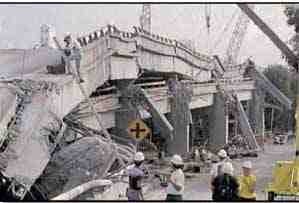
It doesn’t seem possible, but at 5:04 p.m. PT on Saturday, it will have been 20 years since the earth shook in the San Francisco Bay Area.
A 7.1 magnitude earthquake brought the first (and only) Bay Bridge World Series to a stunning halt and it would be 10 days before the Series resumed. It ended two days later with the Athletics completing a four-game sweep.
My memories of that day remain vivid.
Tacoma News Tribune baseball writer Larry LaRue and I were staying in Alameda with a longtime friend of mine, the late, great Dr. Sebastian Russo, the team dentist for the Athletics and Raiders at the time. Around 2:30 that afternoon, with me behind the steering wheel, we headed for Candlestick Park, driving over the Bay Bridge shortly before 3 p.m., We arrived at Candlestick around 3:30, parked the car and found our assigned seats — which happened to be in the football press box, which overhangs the facility between the first and second decks.
Everything was normal. The Giants and Athletics were preparing for that night’s Game 3 of the Fall Classic and the stadium was filling up quickly for the first pitch.
I was talking on the telephone with Seattle Post-Intelligencer Sports Editor Glenn Drosendahl — when all of a sudden the press box started to move. Having lived in San Jose for several years, I recognized the feeling of an earthquake and this one was similar to a couple of others that I had experienced. We continued our phone conversation, figuring out whether I should refer to the earthquake in my game story, or make it a separate story after the game. In the meantime, esteemed Chicago baseball writer Phil Rogers wanted in the worst way to get the heck out of the place and proceeded to scramble away from his assigned seat — running on the top of the table, knocking everthing in his path out of the way. It was not one of his moments of glory.
I looked up and saw the light standards swaying. I looked down and the players were coming out of their respective dugouts, trying to figure it all out, looking for their families.
It was still dusk and no one was sure about the immediate impact on Game 3 — or beyond. When the shaking stopped, the fans cheared. I found that hard to believe. At first, we heard the start of the game would be delayed. But reports from the outside started coming in and indicated that there had been some severe damage. Without electricty, we had no idea how bad it really was. Much later, I saw video of the Bay Bride and two-story viaduct in Oakland as to how much damage there was. The first thing that popped in my mind was that we had driven over that road just two hours earlier. What if the earthquake had happened about two hours earlier? It was a sobering thought, for sure.
Dusk turned to in darkness and the media was instructed by MLB officials to leave the ballpark.
We couldn’t write our stories because there was no electricity. We couldn’t dictate anything because there was no phone service. This was before cellphones.
So, out in the dark we went. Post-Intelligencer columnist John Owen had taken a cab to Candlestick that afternoon and had no way to get back to his hotel, so he, LaRue and I went to my rented car and inched our way out of the still-crowded parking lot. We drove away — not sure how we were going to get back to Alameda, located on the other side of the Bay Bridge, which obviously was closed and even less sure how we would write our stories and get them to our respective newspapers.
As we left a darkened Candlestick, we took 101 towards the City, discovering along the way that there were no lights anywhere. While I drove, LaRue was in the front seat writing his story and Owen was in the backseat writing his column. The inside dome light wasn’t the greatest, but it worked.
Thankfully, I had lived in San Jose for many years and realized that the best way to reach Alameda was to take 280 south from San Francisco to San Jose and then take the Nimitz Freeway north to Oakland.
As I drove south, we kept waiting to see some lights. And waiting. And Waiting. Finally, when we arrived in Palo Alto, there was light. So I drove to the nearest pay phone. Luckily, John had a penlight flashlight that was powerful enough for him to see his copy and read it over the phone to a P-I copy clerk, who typed the column. It must have been around 8 p.m. at the time. LaRue then dictated his story to his office in Tacoma. Meanwhile, I was in the car writing my own story.
Fortunately, the little flashlight had enough power remaining for me to dictate my story as well.
Mission accomplished, we climbed back into the car, drove to San Jose and on up to Alameda, arriving at around midnight. The good doctor was waiting for us, though not sure where we were or when (or if) we could get back.
The three scribes spent the night in Alameda and John returned to SF the next day via BART, which amazingly had not been damaged by the quake.
I remained in the Bay Area for several days, covering daily news briefings in San Franciso by then-Commission Fay Vincent, and writing “news” stories about the devastating quake that killed more than 60 people and injured more than 3,500 more.
Let me tell you, riding BART underwater was no picnic — especially the first time.
After a few days, I returned to Seattle and waited for the Fall Classic to resume. It finally did and I returned to cover the final two games and this was one Series when people were satisfied that it lasted only four games.
Including me. Even 20 years later.
— Jim Street
A ‘Cy’ of relief for Felix?
Some good news from the Twin Cities.
Royals right-hander Zack Greinke, figured to be Felix Hernandez’s main competition for the American League Cy Young Award, surrendered four earned runs in six innings against the Twins earlier today.
That’s as many runs at Greinke had surrendered in is previous seven starts put together and possibly opened the door for King Felix, who makes his final start of the season on Sunday against the Rangers.
Greinke finished the season with a 16-8 record and 2.16 ERA. Felix goes into his final outing with an 18-5 record and 2.49 ERA. Another strong performance figures to boost his Cy Young chances a whole bunch.
If he does win the award, he would join soon-to-be Hall of Fame left-hander Randy Johnson as the only Mariners to win the award.
— Jim Street
Ichiro, Felix, White honored
For the fourth time in his nine seasons with the Mariners, Ichiro was selected as the team’s Most Valuable Player by the local chapter of the Baseball Writers Association of America.
All Ichiro did was become the first player in MLB history to have nine consecutive 200-hit seasons, reached the 2,000-hit mark in lickity-split fashion, made it nine-for-nine in All-Star Game selections and most likely will be awarded his ninth Gold Glove Award for defensive excellence.
Ichiro shared the award with Bret Boone in 2001 and won it outright in ’04, and ’07.
Ace right-hander Felix Hernandez was the overwhelming winner of the Most Valuable Pitcher Award — his first.
He has an 18-5 record and 2.49 ERA going into Sunday’s start against the Rangers and is among the leading Cy Young Award candidates.
Also, right-handed reliever Sean White, who started the season in the Minor Leagues but ended up making 52 appearances, was selected by the coaching staff as the Unsung Hero Award winner.
He posted a 3-2 record and 2.80 ERA before having season come to an premature end because of an injury.
Each of the award-winners received a plaque — and a handshake.
— Jim Street
Ichiro needs run on runs to keep streak going
There isn’t a lot that Ichiro hasn’t accomplished this season, but there is something missing.
*He went past the career 2,000-hit mark in a game against the Athletics in Oakland in August
*He reached the 200-hit level for a record-breaking ninth consecutive season on Sept. 13 in Arlington during the second game of a doubleheader.
*He never went hitless in back-to-back games until Sept. 26-27 in Toronto, ending a streak of 180 games without back-to-back o-fers, the longest streak since Doc Cramer in 1934-35.
*He had his first, second and third walk-off hits of his career. Imagine that.
*He had his first ejection in either Japan or the United States (actually, it was in Canada) last weekend.
But one thing Ichiro probably won’t do for the first time in his nine All-Star seasons with the Mariners is score 100 runs.
He went into Wednesday night’s game against the Athletics with 85 runs scored and just five games remaining. He currently is tied with Lou Gehrig for the modern record of most seasons with at least 200 hits and 100 runs scored — eight. Ichiro and Willie Keeler are the only players to have had 200-100 seasons eight consecutive seasons.
— Jim Street
Taking a stroll with Junior
Ken Griffey Jr., has another souvenir for his bulging trophy case.
The walk he coaxed off Jays reliever Jeremy Accardo in the ninth inning last night was the 1,300th free pass of Junior’s Hall of Fame career. The ball (or one just like it) was given to him after the game with the proper description written by clubhouse manager Ted Walsh.
That got P.R. director Tim Hevly to thinking — how many miles is 1,300 walks?
“Three”,” Griffey said when he was asked.
Not exactly.
Those 1,300 walks total 117,000 feet which, divided by 5,280 feet/mile equals 22.16 miles.
Though Griffey’s batting average, .214, is low, he leads the team in walks this season with 60 — two more than injured first baseman Russell Branyan.
The all-time leader in walks is Barry Bonds, who had 2,558 during his 22-year MLB career — or 38.5 miles worth of walking.
— Jim Street
 Street's Corner